 |
 |
Kent Online Parish Clerks |
|
 |
 (Click photo for larger view) |
Folkestone Parish |
|
|
|
Kent Online Parish Clerks |
|
|
(Click photo for larger view) |
Folkestone Parish |
|
 We are sorry, there is no Online Parish Clerk for this parish. We are sorry, there is no Online Parish Clerk for this parish. |
We have no other information or data for this parish except what is accessed by or detailed on this page. | If you wish to volunteer for this post or have data you wish to contribute, please use the appropriate link on our Contacts page. |
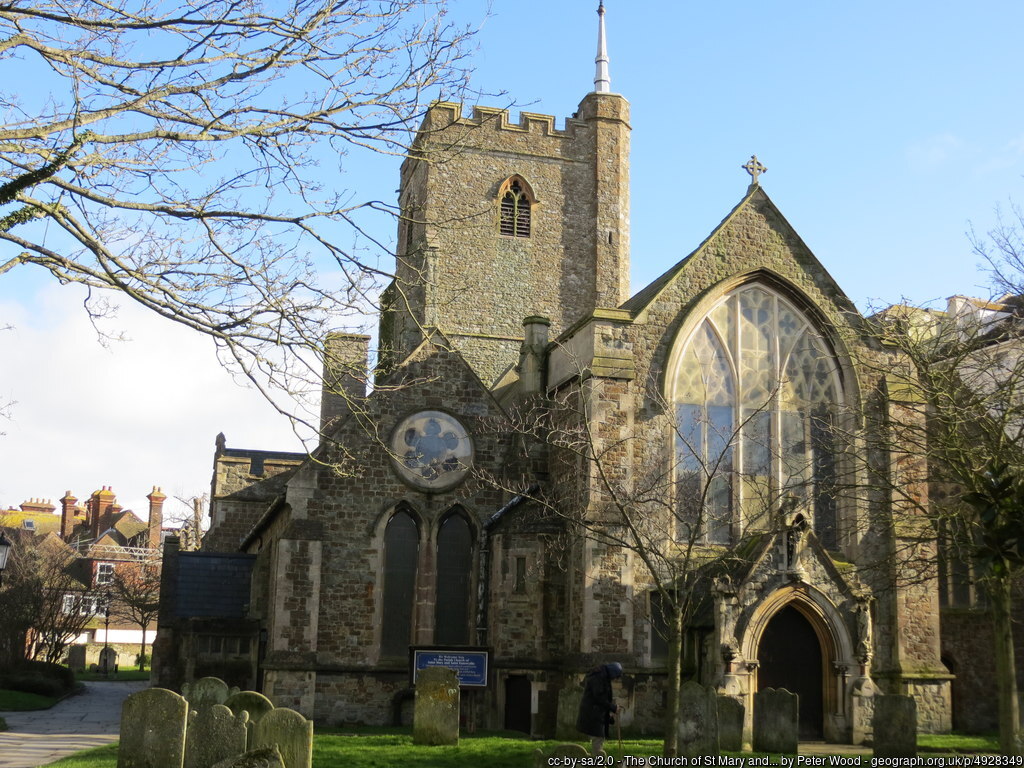
FolkestoneFolkestone is, ecclesiastically, in the archdeaconry of Canterbury and in the deanery of Dover. The parish church is named for St Mary and St Eanswythe with original parish registers commencing 1635. Archdeacon's Transcripts begin 1563 and Bishop's Transcripts in 1603. Folkestone is a town, a parish, a sub-district and a hundred in Kent. The town stands on the coast, and on a branch of the Southeastern railway, 6-1/2 miles west-south-west of Dover, and 15 miles south-south-east of Canterbury. Its name was written Folcestane by the Saxons, and Fulchestan in Domesday book; and has been regarded as a corruption of variously Fulke's town, signifying "the town of Fulke", Folk's-stane, signifying "the fairies' rock", and Flos-stane, signifying "the break in the rock". Its site is a congeries of cliffs and hillocks, such as to have induced Thomas Ingoldsby to say, - "Rome stood on seven hills; Folkestone seems to have been built on seventy". Folkestone hill is 575 feet high; and commands a fine view of the town, and a rich and extensive prospect over coast and sea. A ridge of cliffs, overhanging a coast-road, extends, on the one hand, to Sandgate; another ridge of cliffs extends, on the other hand, all the way to Dover; and these cliffs, besides affording very fine sea-views, command, in clear weather, a distinct prospect of the French coast. The original town was known to the Romans, but has disappeared beneath the waves; and even the succeeding town dates from remote times, but suffered such ravages by the Danes and the French, and has, at different times, sustained such damage by the beating of the billows, that it now presents far fewer ancient remains than might have been expected from its antiquity. Roman coins and bricks have been found; pieces of Saxon arms and pottery also have been found; but the extant ancient remains consist merely of traces of building, and can be observed only as shapeless fragments embodied in walls. A Roman watch tower is believed to have stood on a cliff a short distance south of the present parish church; a castle was built on the same site, about the year 630, by Eadbald, King of Kent; a nunnery was founded, within the castle, by Eanswith, daughter of King Eadbald, - was ravaged by the Danes, - and was afterwards replaced by a Benedictine priory; another castle, for a fortress, was built on the same site, by the Avranches de Abrincis, who became lords of the manor soon after the Norman conquest; but all these structures, and the very cliff on which they stood, have been swept away by the sea. Part of the area which they occupied is marked by the present Bail - a name corrupted from ballium; a reservoir here, called the Bail-pond, is supplied from a spring which St. Eanswith is fabled to have brought hither by a miracle; and a reach of ancient wall still standing on the east side may perhaps be Norman. The Benedictine priory was rebuilt on another site, at a distance of 560 yards; was made a cell to Lonlay abbey, in Normandy; and served, for a time, to maintain the previous importance of the town, by attracting devotees; and some slight traces of building, supposed to indicate its site, are still observable in the parsonage garden. "Great ruins of a solemn old nunnery" are mentioned by Leland as existing in his time; and Roman tiles are said, by another writer, to have been traceable among these ruins; but all these, both walls and tiles, have vanished. The town, at Domesday, had five churches, and was an honour held by Nigel de Mundeville; but, in spite of its continuing to possess the attraction of Eanswith's priory, it appears to have declined; and, after the Reformation, it sank into obscurity till toward the end of last century [18th century], when it came into notice as a fishing town. But, by the opening of the railway to it in 1844, by consequent improvements on its harbour, by the constituting of it a packet station to Boulogne, and by the discovery of its position and environs as eminently suited for sea-bathing quarters, it has undergone vast change, and become a place of much stir and concourse. The town, previous to the recent change upon it, was one of the most disagreeable in England. It was ostensively a fishing town, but practically a smuggling town; it possessed, in intricacy of site and brokenness of shore, wonderful facilities for contraband operations; and it presented every kind of repulsion to the visits of strangers. Its thoroughfares were ill-paved and muddy; its streets were mere alleys, on steep inclines, partly progressing and partly communicating with one another by coarse flights of steps; and many of its houses were badly built, almost overtopped others, and contained hiding-holes and remote rooms or cellars for the storage of smuggled goods. But, in the course of the recent change, the old streets were, partially or wholly, renovated; new streets were formed; numerous villas were built; warehouses were erected; a custom-house establishment was provided; a fine harbour was constructed; a fine townhall, a market place, and a magnificent hotel were erected; and all sorts of appliances, suitable both for a packet station and a sea-bathing resort, were created. The railway company purchased the old harbour; enclosed a space of 14 acres; and brought the railway hither through difficult passages by means of vast rock-cuttings, and along a grand viaduct. Even Rendezvous Street, formerly an alley noted as the meeting place of smugglers, has been enlarged to a uniform width of 40 feet, and rebuilt, in a pleasing style, entirely on one side, and largely on the other. The old Tontine Street also, which was formerly a nuisance amid tortuous lanes, has been swept away, and replaced by a good new street. An elegant drinking fountain, of bronze, with square base, and about 8 feet high, has been constructed at the outlet facing the harbour. The new townhall was completed in 1861; stands on a plot of 100 feet by 60; is in the Grecian style, with both Corinthian and Ionic features; contains a magistrates' room, a council room, a reading room, and other apartments; and cost about £12,000. The new market is behind the townhall, and measures 50 feet by 40. The new custom house and the railway station, at the harbour, are elegant and commodious. A strong battery is on the heights; and three martello towers are on the coast. The parish church stands on the west cliff, overtopping all the town; has an interesting early English chancel, with very high pitched roof; lost great part of its nave by a storm in 1705; presents a defaced appearance in consequence of only a portion of the nave having been built; has a tower, between the nave and the chancel; and contains a later English font, a late decorated altar-tomb to one of the Fiennes family, a monument of the 17th century to John Herdson, and a brass to Joan Harvey, the mother of Dr. Harvey, the discoverer of the circulation of the blood. Christ Church, serving for a chapelry constituted in 1851, is an edifice in plain Gothic. A church for mariners and fishermen on the east side of the railway arches, was opened in 1862. Two new ecclesiastical chapelries, called Holy Trinity and St. Peter, were constituted in 1868. A Wesleyan chapel, at a cost of £4,000, was built in 1866. There are chapels for Independents, Baptists and Quakers; an endowed school with £43; three other public schools; a literary institution; a dispensary; and reading rooms and libraries. Folkestone has a head post office, a money order office and a savings bank, a railway station outside the town, called Folkestone Junction, with telegraph, another railway station at the harbour, with telegraph, a banking office, and four chief inns; is a seat of sessions, a coast guard station, and a member of the cinque port of Dover; and publishes two weekly newspapers. Markets are held on Wednesdays and Saturdays; and a fair on 28 June. A considerable fishery is carried on, but is not so prosperous as formerly. Steamers sail twice a day to Boulogne. The vessels belonging to the port, at the beginning of 1863, were 7 small ones of aggregately 111 tons, and 24 large ones of aggregately 3,381 tons. The vessels which entered, in 1862, were 1, of 50 tons, from the colonies; 9, of aggregately 1,365 tons, from foreign countries; and 272, of aggregately 32,785 tons, coastwise. The amount of customs, in 1867, was £12,731. The piers of the harbour were commenced in 1808, and were carried out by Telford; but they did not become available till the opening of the railway. A lighthouse, with fixed light, was erected in 1810; and has a height of 36 feet. The bathing grounds afford similar advantages to those of Dover and Ramsgate, with greater seclusion. The climate is salubrious; the environs and neighbourhood abound with excursion places; and a chalybeate spring is about 1/2 a mile distant. The town is a borough by prescription; is governed by a mayor, four aldermen, and twelve councillors; and forms part of the parliamentary borough of Hythe. Real property, £34,445; of which £61 are in gas works, and £49 in quarries. Population in 1851, 6,726; in 1861, 8,507. Houses, 1,478. The town gives the title of Viscount to the Earl of Radnor. Philpott, the author of "Villare Cantianum", and Harvey, the discoverer of the circulation of the blood, were natives. The parish includes also part of the village of Sandgate. Acres, 4,690; of which 340 are water. Real property in 1860, besides that of the borough, £7,020. Population in 1861, 9,674. Houses, 1,691. Population of the ecclesiastical Christ church chapelry, 2,744. Houses, 486. The property of the chapelry is all in one estate; but that of the rest of the parish is subdivided. The manor went from Nigel de Mundeville to the Avranches; passed to the Crevecœurs, the Clintons, and others; and belongs now to the Earl of Radnor. Broadmead Manor late medieval timber-framed house with an 18th century sandstone and tile facade. Features include sash windows, gabled dormers, and a Victorian bay. 2The martello tunnel, on the railway, in the vicinity of the town, is 1,908 feet long; and the Foord viaduct of the railway, over the town valley, is 758 feet long. The head living and that of Christchurch are vicarages, and those of Holy Trinity and St. Peter are perpetual curacies, in the diocese of Canterbury. Value of the head living, £300 with a habitable glebe house. Patron of that, the Archbishop; of Christchurch and Holy Trinity, the Earl of Radnor; of St. Peter, the Vicar of Folkestone. The sub-district includes also the parishes of Hawkinge and Cheriton, with Shorncliffe camp; and is in Elham district. Acres, 7,072. Population in 1861, 17,341; of whom 4,204 were military in Shorncliffe camp. Houses, 2,057. The hundred excludes Folkestone borough; contains six parishes, and parts of three others; and is in the lathe of Shepway. Acres, 20,252. Population in 1851, 4,462. Houses, 799.1 Ford forstall or Foord, is about a mile northward from the town, there rises a strong chalybeat spring. This part of the parish, by far the greatest part of it, as far as the high road from Dover, through it, towards Hythe, is within the jurisdiction of the hundred of Folkestone, and the justices of the county. The small part on the opposite, or southern side of that road is within the liberty of the town or corporation of Folkestone, where the quarry or sand hills, on the broken side of one of which, the town is situated, are its southern maritime boundaries.3 1John Marius Wilson, comp. The Imperial Gazatteer of England and Wales. (London, England: A. Fullerton & Co., 1870). 2Historic England Folkestone and Hythe Local History 3Edward Hasted, 'The town and parish of Folkestone', in The History and Topographical Survey of the County of Kent: Volume 8 (Canterbury, 1799) Folkestone Bibliography-- various. 'Archaeologia Cantiana'. Publisher: Kent, England: Kent Archaeological Society, various dates. Volumes 1 through 139 are available to view free on the Kent Archaeological Society website. . [Note: The following volumes can be found on archive.org: 1, 2, 3, 4, 5, 6, 7, 8, 9, 10 (1876), 11, 12, 13 (1880), 14, 15, 16, 17, 18, 19, 20, 21, 22, 23, 24, 25, 26, 27, 32, 34, 35, vol. 1907 supplement.]
--. 'Folkestone : MIs : Medway series of monumental inscriptions', vol. 8. [Microfiche.] Published: Waterlooville, The Parish Register Transcription Society, n.d. Cooper, Robert M., contr.. 'The Literary Guide & Companion to Southern England'. Publisher: Athens, OH: Ohio University Press, 1998. Great Britain, Ordnance Office. 'Ordnance Plan of the Parishes of Warehorne, Ruckinge, Folkestone and Snave, with Warchorne Ph det., Nos. 1 to 7, Folkestone Ph det., Nos. 1 to 8, Snave Ph det., Nos. 1 and 2, and Kenardington Ph det., No. 2.'Publisher: Southampton, [1872] Great Britain, Public Record Office. 'Calendar of the patent rolls preserved in the Public Record Office--Edward II, Vol. 1. 1307-1313'Each volume has own index. Publisher: Genealogical Society of Utah d.b.a Historical Books on FamilySearch Great Britain, Public Record Office. 'Calendar of the patent rolls preserved in the Public Record Office--Edward II, Vol. 4 Great Britain. Public Record Office Great Britain - Public records - Inventories, registers, catalogs; Great Britain - History - Plantagenets, 1154-1399 - Sources; Genealogical Society of Utah d.b.a Historical Books on FamilySearch Great Britain, Public Record Office. 'Calendar of the close rolls preserved in the Public Record Office--Edward III, Vol. 4. 1337-1339'. Publisher: Genealogical Society of Utah d.b.a Historical Books on FamilySearch Great Britain, Public Record Office. 'Calendar of the patent rolls preserved in the Public Record Office--Edward IV, A.D. 1461-1467'. Publisher: Genealogical Society of Utah d.b.a Historical Books on FamilySearch Great Britain, Public Record Office. 'Calendar of the close rolls preserved in the Public Record Office--Henry VI, Vol. 5. 1447-1454'. Publisher: Genealogical Society of Utah d.b.a Historical Books on FamilySearch Great Britain, Public Record Office. 'Calendar of the patent rolls preserved in the Public Record Office--Philip and Mary, Vol. 2. 1554-1555. Publisher: Genealogical Society of Utah d.b.a Historical Books on FamilySearch Great Britain, Public Record Office. 'Calendar of the patent rolls preserved in the Public Record Office--Philip and Mary', Vol. 3. 1555-1557. Publisher: Genealogical Society of Utah d.b.a Historical Books on FamilySearch Great Britain, Public Record Office. 'Inquisitions and assessments relating to feudal aids : with other analogous documents preserved in the Public Record Office, A. D. 1284-1431', Vol. 3. Publisher: Genealogical Society of Utah d.b.a Historical Books on FamilySearch; http://www.familysearch.org. Great Britain, Exchequer. 'The book of fees commonly called testa de nevill, pt. 3'. The Book of fees contains information about the holdings of feudal tenants. Publisher: Genealogical Society of Utah d.b.a Historical Books on FamilySearch; http://www.familysearch.org. Hall, Hubert, 1857-1944. 'The Red book of the Exchequer - Liber rubeus de Scaccario, Vol. 3'. The Red book of the Exchequer was a register intended to preserve important documents comprising charters, statutes of the realm, public acts (Placita), private deeds and ordinances, correspondence. Publisher: Genealogical Society of Utah d.b.a Historical Books on FamilySearch; http://www.familysearch.org. Glencross, Reginald Morshead. 'Administrations in the Prerogative Court of Canterbury, Vol. 1. 1559-1571'. Publisher: Genealogical Society of Utah d.b.a Historical Books on FamilySearch; https://www.familysearch.org. Ham Street History Society. 'Hamstreet and Folkestone : a photographic history to celebrate 2000AD.' Publisher: Hamstreet, Kent: Ham Street History Society, 2000. ISBN 0953917606. Holt, Anne D.. 'History of Parliament ... 1439-1509 Wedgwood, Josiah Clement, Baron, 1872-1943. Publisher: Great Britain. Parliament. House of Commons. Genealogical Society of Utah d.b.a Historical Books on FamilySearch Hasted, Edward. 'The History and Topographical Survey of the County of Kent; Containing the antient and present state of it, civil and ecclesiastical; collected from public records, and other authorities: illustrated with maps, views, antiquities, etc. The second edition, improved, corrected, and continued to the present time'. 12 volumes. Publisher: Canterbury: Printed by W. Bristow, 1797-1801. URL: British History Online Hussey, Arthur. 'Notes on the churches in the counties of Kent, Sussex, and Surrey, mentioned in Domesday book, and those of more recent date'. Publisher: London J.R. Smith,(1852). Letters, Dr. Samantha. 'Kent', Gazetteer of Markets and Fairs in England and Wales to 1516 (2005). URL: British History Online. Mackie, S. J. 'A Descriptive and Historical Account of Folkestone and its Neighbourhood with Gleanings from the Municipal Records', P. 219. Reprinted from the "Folkestone Express". 2nd edition. Folkestone, Kent, England: Printed and Published by J. English, 1883. Muriel, L. A. 'Folkestone : M 1754-1812 : Kent registers vol. 20'. Published 2005. Rickard, Gillian. 'Kent Communicants Lists 1565-1567: v.1: Appledore, Brookland, Burmarsh, Dymchurch, Ebony, Fairfield, Lympne, New Romney, Folkestone, Saltwood, Stone in Oxney, Tenterden, West Wythe, Woodchurch. Publisher: --. Page, William, 1861-1934, ed.. 'The Victoria history of the county of Kent'. Publisher: London: Constable (1908). URL: British History Online Sharp, J. E. E. S., ed.. 'Inquisitions Post Mortem, Edward I', Calendar of Inquisitions Post Mortem, various volumes: Edward I. Published:(1906). URL: British History Online. Sharp, J. E. E. S., ed.. 'Inquisitions Post Mortem, Edward II', Calendar of Inquisitions Post Mortem, various volumes: Edward II. Published:(1910). URL: British History Online. Sharp, J. E. E. S., ed.. 'Inquisitions Post Mortem, Edward III', Calendar of Inquisitions Post Mortem, various volumes: Edward III. Published:(1938). URL: British History Online. Sharp, J. E. E. S., ed.. 'Inquisitions Post Mortem, Henry III', Calendar of Inquisitions Post Mortem, various volumes: Henry III. Published:(1904). URL: British History Online. Kirby, J. L., ed.. 'Inquisitions Post Mortem, Henry IV', Calendar of Inquisitions Post Mortem, various volumes: Henry IV. Published:(1992). URL: British History Online. Kirby, J. L., ed.. 'Inquisitions Post Mortem, Henry V', Calendar of Inquisitions Post Mortem, various volumes: Henry V. Published:(1995). URL: British History Online. Cyril Flower, M. C. B. Dawes and A. C. Wood, ed.. 'Inquisitions Post Mortem, Henry VII', Calendar of Inquisitions Post Mortem, various volumes: Henry VII. Published:(1955). URL: British History Online. M. C. B. Dawes, H. C. Johnson, M. M. Condon, C. A. Cook and H. E. Jones, ed.. 'Inquisitions Post Mortem, Richard II', Calendar of Inquisitions Post Mortem, various volumes: Richard II. Published:(1988). URL: British History Online. Location of RecordsThe following list of records is not intended to be exhaustive. There are many records that are awaiting discovery in archive offices throughout Kent and England. This list is intended only to set out those records that are available via at least two relatively easy-to-access avenues. If you have used or discover a record that would be of benefit to other researchers, that is not on this list, please send me an email with the details of the archive - name, address and archival call number. Census
Church Records, Church of England
Church Records, Non-Conformist
Parish chest records
Workhouse and Poor Law Records
Land Records
Assizes and Sessions Records
|
| Record Type | Dates | Archive 1 (Addresses) |
Corresponding LDS Family History Library film numbers (Find a centre near you) |
| Hearth tax | Currently under revision | ||
| Victuallers Recognizances | Currently under revision | ||
| Churchwarden's Presentments | Currently under revision | ||
| Parish rate books | Currently under revision |
| Record Type | Dates | Archive 1 (Addresses) |
Corresponding LDS Family History Library film numbers (Find a centre near you) |
| Currently under revision | |||
ca 630 - King Eadbald founded a nunnery on the cliffs for his daugyhter, St. Eanswythe
ca 867 = Viking raids - second church destroyed
1052 - third church destroyed by Earl Godwin
1086 - population estimated to be about 800
1095 - Nigel de Muneville succeeded as Lord of the manor
1313 - Charter received from King Edward II entitling it to a Mayor, Bailiff, 12 Jurats
1806 - Martello Tower #8 built
1814 - original primary school instituted by William Wilberforce
1843 - railway built and viaduct crossing the Foord valley also built by William Cubitt
3 Feb 1856 - British packet "Josephine Willis" collided with the "Mangerton", a steamer and foundered approximately 6.4 km south of Folkestone Harbour. It was en route from London to Auckland with passengers and general cargo.
1873-4 - Baptist Church built by Joseph Gardner
1885 - Leas cliff lift constructed by Messrs. Waygood & Co.
1886-1888 - Library and Museum built
1895 - Grace Chapel designed by Frank Newman, Hotel Metropole designed by T. W. Cutler
1890 - pump room added to the Leas Lift
1940-1945 - 77 air raids and six V1 attacks
1801 - 3,257
1811 - 3,697
1821 - 3,989
1831 - 3,638
1841 - 3,723
1851 - 6,726
1861 - 8,507
1871 - 11,304
1881 - 15,561
1891 - 17,657
1901 - 18,500
1911 - 33,974*
1921 - 38,157*
1801 - 447
1811 - 535
1821 - 552
1831 - 658
1841 - 690
1851 - 823
1861 - 1,171
1871 - 1,647
1881 - 3,736
1891 - 6,575
1901 - 12,469
1911 - 33,974*
1921 - 38,157*
* This is the total population for town and rural areas.
**The parish was effected by the operation of the Divided Parishes Acts, but the Registrar-General failed to obtain particulars of every such change. The changes which escaped notification were, however, probably small in area and with little, if any, population. Considerable difficulty was experienced both in 1891 and 1901 in tracing the results of changes effected in civil parishes under the provisions of these Acts; by the Registrar-General’s courtesy, however, reference has been permitted to certain records of formerly detached parts of parishes, which has made it possible approximately to ascertain the population in 192! of parishes as constituted prior to such alterations, though the figures in many instances must be regarded as partly estimates.
London 61.4 mi.
Canterbury 13.7 mi.
Ashford 13.6 mi.
Bromley 54.3 mi.
Chatham 33.2 mi.
Cranbrook 27.3 mi.
Dartford 48.6 mi.
Deptford 58.6 mi.
Dover 6.9 mi.
Faversham 19.9 mi.
Gravesend 42.0 mi.
Greenwich 56.9 mi.
Hythe 3.3 mi.
Maidstone 30.3 mi.
Margate 22.8 mi.
Milton Regis 25.9 mi.
Queenborough 29.1 mi.
Ramsgate 20.3 mi.
Rochester 36.3 mi.
Sandwich 15.6 mi.
Sheerness 30.6 mi.
Tenterden 20.6 mi.
Tunbridge 39.2 mi.
Woolwich 55.3 mi.
 |
|||
 |
Contact Us Privacy Policy Terms of Use |
© 2006, Kent Online Parish Clerks, all rights reserved. No part of this page or web site may be reproduced either in part or in its' or their entirety in any manner whatsoever without prior written permission of Kent Online Parish Clerks or its' assigns or successors, as the case may be, and the author hereof.   |
|